This blog is a forum for discussion of literature, rhetoric and composition for Ms. Parrish's AP Language and Composition class

Wednesday, February 3, 2010

The Paradox of the Need for Privacy and the Need for Understanding

After reading the article on Paradox and the Need for Privacy and the Need for Understanding, I was left wondering, why do people change and how does time affect this change?
Because I wasn't in class today, I was left to figure out the meaning of the article on my own, so this might be completely wrong...but, I think that Madden's argument can be found in the line, " everyone hungers for human understanding while simultaneously desiring an inviolable privacy" (Madden 1). Throughout the article, I found that Madden suggests that individuality is less present as one grows older, and therefore, it sounded as if he was saying that one conforms to society as time goes on. This is certainly true for Mick as a character. Being a preteen (where we are right now anyways) she is on the path of self discovery, and wants her own voice to be heard. This is seen when she writes in chalk on the walls of the new home in town, and in the way that she dresses. According to the article, she is forced into a rapid maturity because of certain choices that she has made. Mick is shown at three different stages in the article: as a preteen, as an teenager, and then suddenly as a woman. I think the fact that McCuller chooses to demonstrate her at these different ages definitely supports the argument that Madden is making-Mick decides to be a part of society and act like a "normal" girl after her "sexual awakening". Previously she enjoyed the loneliness when she acted and dressed like a boy, but at the same time she wanted to tell someone about the loves that she had experienced. Mick's change over time supports the argument that over time people change and so does their character and personality.
Also, I was thinking that the fact that McCullers decides to use so many interconnected characters definitely demonstrates the idea of dependence on others during personal discovery...throwing that out there!

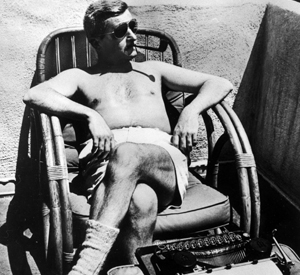
Fugue and Counterpoint

"This book is planned according to a definite and balanced design. The form is contrapuntal throughout. Like a voice in a fugue each one of the main characters is an entirety in himself - but his personality takes on a new richness when contrasted and woven in with the other characters in the book."

-- McCullers (quoted by Fuller in "The Conventions of Fugue and Counterpoint")


It's difficult to doubt the musical influence of McCuller's novel - Mick's greatest weakness is the classical music on the radio; the first character's name is "Singer"; "She started on the same tune and said the same thing over and over..." (McCullers, 50); the list goes on.

Similarly, the presence of counterpoint and fugue is hard to ignore - the book's characters tell their stories in a very similar, repeating manner, much as a musical fugue repeats its components to create a new piece that is harmonically sound.

Take, for example, the fact that each chapter in part I begins with a description of the specific time of day: "On a black sultry night in early summer Biff Brennon stood...(13); "the sun woke Mick early..." (33); "late in the afternoon Jake Blount awoke...(53)". Similarly, in part II, each chapter (thus far) begins with a description of the season - "this summer was different..." (97) and "by October the days were blue and cool" (121)

Still, my question is whether or not these elements of counterpoint and fugue allow each character to "take on new richness" or blend them all into one. On the one hand, the similar yet different manners in which the characters act contrast to highlight each of their differences. Yet, on the other hand, much like a musical fugue, each individual part refrains from being it's own piece and begins to blend together in a conforming manner. Do the characters conform or stand out as a result of McCuller's musical composition?

The Paradox of the Need for Privacy and the Need for Understanding

After reading and analyzing the article "The paradox of the need for privacy and the need for understanding" the question that i was left with was, in human nature, does this paradox change over time?
It is within human nature to desire privacy, individuality and self alienation to an extent, while still wishing to be connected with and accepted by society through mutual understandings from one human being to another. This was the basis of the article, however Madden also included much detail regarding age and growing older. Mick is young (at the point we are at in the novel), however the article reveals that with age she changes. Madden states, "We see her in various situations, reacting variously, exhibiting in her own eccentric way all the characteristics of an adolescent girl trying to achieve womanhood, but fearing to succeed." I feel that this fear of age, yet still desirable growth in age is reflective of the paradox Madden is addressing in his article. Later he says again, "In growing up, he (Bill) has failed her." I felt that Madden was suggesting that as one grows older this paradox deteriorates and becomes less important. Perhaps individuality grows less vital to a person with age? 
I suppose, as I stated before, what i am wondering is if Madden is trying to portray, or indirectly exhibit, that the paradox of the need for privacy and that for understanding shifts, or becomes less powerful, significant or influential over time. 

The Paradox of the Need for Privacy and the Need for Understanding - Does the author refute his own argument?

Today in class we decided collectively that the setence "everyone hungers for human understanding while simultaneously desiring an inviolable privacy'' (1), was most likely the author's thesis in this article. It essentially, as we already said, restated the title and stated what Madden was going to say in the following pages.

As we spoke of paradox we began to discuss this idea that many of the characters go to Singer to talk to - more for their own benefit than Singer's. Madden even says that the Doctor Copeland " was more at peace when he could talk to the uncomprehending deaf-mute, Singer. " (6).

Perhaps it is just me, but it seems like Madden is refuting his own idea. In the beginning Madden said that everyone hungers for human understanding, yet towards the end explains that Copeland prefered it when he talked to someone who didn't understand. Doesn't this evidence seem to contradict his own idea?

Friday, January 29, 2010

JD Salinger: Obituaries, Discussions, etc.

In the day since Salinger's death, there has already been a lot of speculation about what will happen to the alleged safe full of manuscripts, the rights for a Catcher in the Rye movie, and Salinger's decision to live in solitude for the last five decades of his life.

Amidst all of this, I have noticed a surprising amount being written about the impact that his fiction, not just Catcher, but predominantly that novel, had on students, teachers, and readers in general.

Below are some of the more interesting links I found.

New York Times "Taking a Walk Through Salinger's New York":

The New Yorker's homage to Salinger, including links to all 13 of the stories he originally published there (two of which, "Franny" and "Zooey" later became a novel)

The Huffington Post created a forum for people to blog about Salinger, his work, etc. The forum poses and addresses the questions "How did "Catcher in the Rye" change your life? Where were you the first time you read "A Perfect Day For Bananafish?" Who did you fall more in love with: Franny or Zooey?" It requires a log in but other projects like this that I've seen on the Huffington Post have been really interesting.

And finally, from The Onion (a satirical newspaper)...Bunch of Phonies Mourn JD Salinger
Feel free to comment on our blog as well.

Monday, January 4, 2010

Animal Farm by George Orwell

"Animal Farm" is a very peculiar, yet engaging book, and while it seems to be a story of fantasy, being based around a farm run by animals, its message is one to carry on into our own society. The story centers on a farm known as the Manor Farm, which is run by an evil and cruel man known as Mr. Jones. He mistreats the animals day in and day out, frequently getting drunk and forgetting to feed them. In the barn, the patriarch of the animals is a prize boar referred to as the Major, and he is slowly nearing his death. He decides to spread his acquired knowledge and wisdom with the farm, telling them of a time when there will be a revolution, and the animals will rule the farm and rid themselves of the humans who do nothing except cause them problems. The Major dies soon after, and the animals prepare for the revolution, only to find that it occurs sooner than expected. This leaves the manor in charge of the pigs, especially the two leaders named Snowball and Napoleon, who work to improve life on the farm and increase the standard of living. They create animalism, a new philosophy that includes seven commandments, one of which says that "All animals are equal". However, as life on the farm goes on, there are unexpected twists and turns that affect its inhabitants drastically, and tension brings about some surprising new developments...

The novel itself was written as an allegory to the Russian Revolution and the Soviet Union as a whole, as the plot and characters correlate to certain people and events of the period. However, it is really a critique on all society. It portrays a very important message, that equality will never be a realistic possibility, because while all may be equal, some may "be more equal than others". Also, it shows what happens when one individual gets too much power. The initial intentions may be good, but greed is inevitable, and the power will eventually turn them into the very thing they detest the most. It was also very interesting to see how Orwell used the idea of rewriting the past in this novel. This was a prevalent notion in his other novel, "1984", but it was shown in "Animal Farm" as well. Orwell demonstrated how using terror as a weapon, it is possible even for the past to be revised to match the present, a notion that he seemingly feels to be a huge factor in totalitarianism. Individuals can be convinced that their memories are false, as long as they are threatened, and Orwell clearly finds this point to be significant.

Overall, "Animal Farm", like "1984", is a critique on government, and also in a way a warning to the consequences of becoming mad with power.

Under the Dome

http://www.amazon.com/Under-Dome-Novel-Stephen-King/dp/1439148503/ref=sr_1_1?ie=UTF8&s=books&qid=1262660665&sr=1-1

Stephen King's Under the Dome is novel that deals with how the inhabitants of a small town in Maine try to survive after a mysterious, impenetrable dome unexplainably appears over it, blocking them off from the rest of the world. Though they can still communicate with outsiders via phones and internet, nothing can be done for their safety as citizens begin to strive for power and do anything it takes to stay alive.

The novel deals with humanity as a whole and how we define ourselves as human beings by showing the survival efforts that the people of the fictional Chester's Mill make and how all of them are justified in their own way, simply because each person is just trying to continue his or her own existence. Certain characters hold grudges from before the dome incident against other characters and then battle those same characters since they now see their enemies as legitimate threat to their own survival. Meanwhile, seemingly good people ally themselves with more evil characters when they see that those evil characters hold more power and it would be much safer to be on their side. But it isn't only that, for the main characters soon begin to see themselves as the victims of some cruel, unknown game and believe that the dome was put forth only as a form of torment, much like a group of young children would torment a small animal for fun. Once this realization is made, the novel demonstrates the paradox of being human: we're still animals and are no different from any other species. Like a colony of ants being set aflame by a magnifying glass, in our moments of helplessness most of us will do whatever it takes to survive and abandon all concern for anyone else. Through a few main characters that do end up being selfless and try to help others, King shows that in order to be human in the mental sense, we have to let go of all of our survival instincts and take the time to help those who can't survive. Otherwise, we're just like any other animal.